Redesign

Team
1 Product Designer (me)
2 Product Managers
2 Developers
Focus
System Design
Event Routing
Real-Time Data
Contraints
4 Week Timeline
Existing APIs only
Gaming Regulations
Overview
OwnersBox is a daily fantasy sports platform with multiple game formats including Player Picks, Spin and Draft, Salary Cap, and Lightning Lineups.
Notifications are critical for keeping users informed about contests, player updates, and financial activity.
The existing notification system lacked customization, discoverability, and reliable navigation.
Goal: design a scalable notification system that keeps users informed without overwhelming them.
Problems
User Problems
Notifications buried in settings on mobile
No visible notification bell in the main UI
Notifications disappeared immediately after viewing
Clicking any notification redirected users to the home screen
No customization by game type
Notification categories lacked descriptions
Business Problems
Notifications were underutilized as an engagement driver
Lack of brand activation within alerts
Limited analytics around notification engagement
Constraints
Product Constraints
Must comply with gaming regulations
Too many notifications risk user fatigue
UX Constraints
Limited mobile screen space for notification settings
Need to balance simplicity with customization
Risk of modal fatigue if prompts are too frequent
Technical Constraints
Some notifications required backend event triggers that were not available through existing APIs. We prioritized an MVP set that could be supported by the current infrastructure.
Business Goals
Increase engagement and retention
Use notifications to re-engage players during contests
UX Goals
Keep users informed without overwhelming them
Make notification preferences easy to manage
Build trust through transparent settings
Product Goals
Create a scalable notification system
Route notifications to relevant in app destinations
Support customization by game type
Notification Channels
Notifications were distributed across three channels.
Bell Notifications
Persistent alerts tied to meaningful actions
Remain visible for 7 days
Can be cleared individually or all at once
Examples
Contest updates
Marketing Alerts
Financial activity

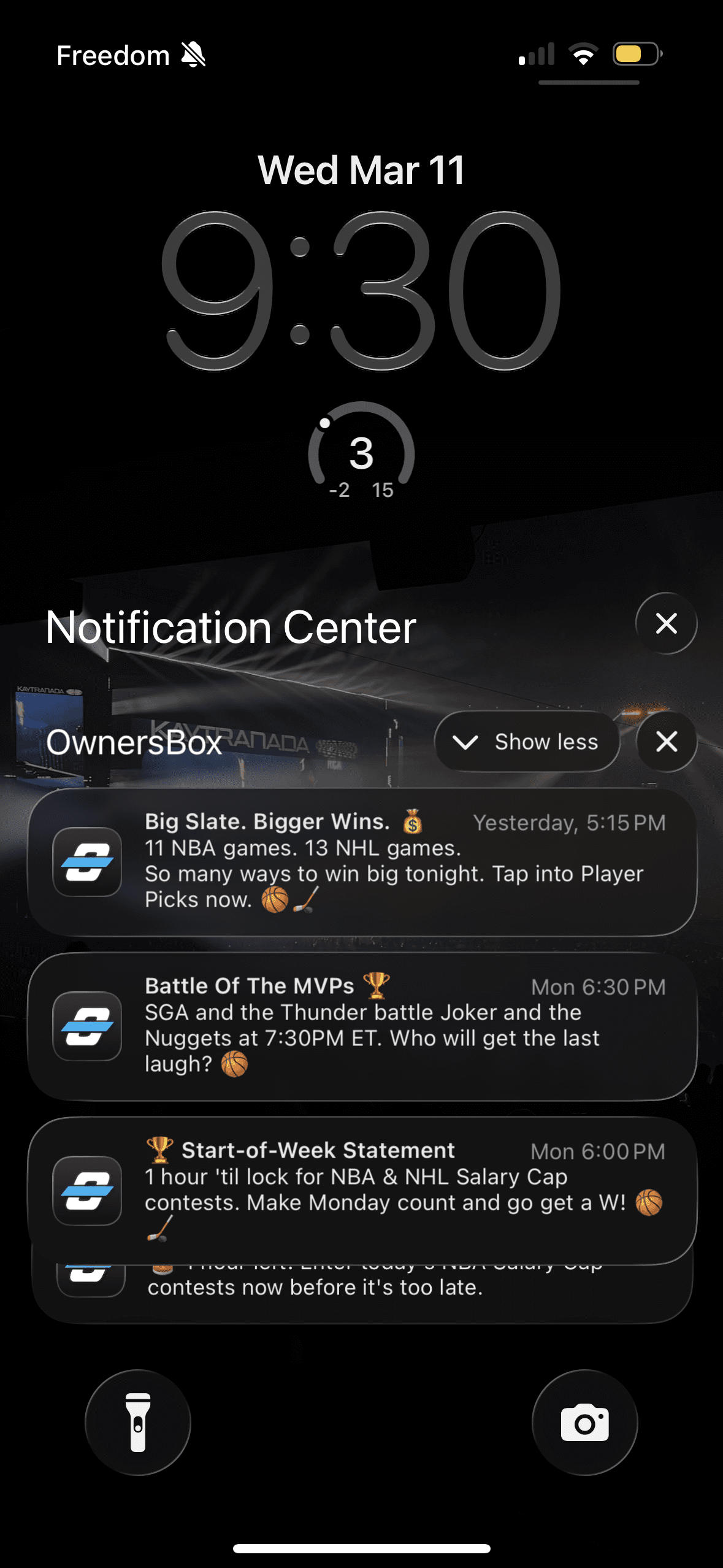
Push Notifications
Time sensitive alerts delivered through the device
Alerts that happen more frequently than bell notifications
Examples
Drafting turns
Marketing Promotions
Email Notifications
Confirmations and longer form updates
Examples
Deposits
Withdrawals
Marketing Alerts
System Design
The challenge was not simply redesigning notification UI.
It required restructuring how notifications are triggered, routed and delivered.

Notification System Architecture Diagram
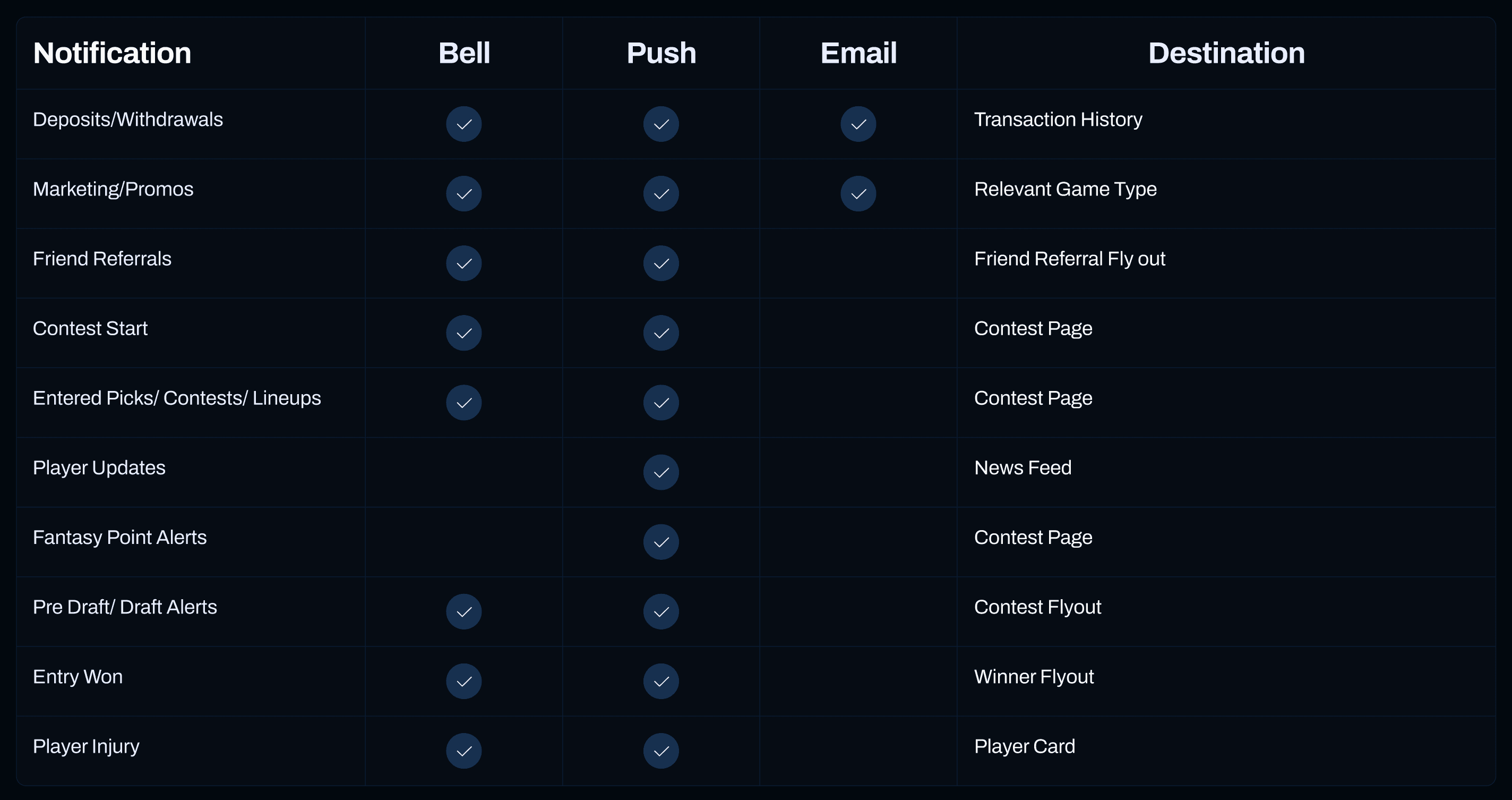
Reducing Notification Noise
Player updates generate extremely high notification volume. [Trades, Status Updates, Transactions etc.]
Instead of flooding the notification bell, these alerts were redirected to the player news feed where users could view updates in context.
These were kept as push notifications but not kept in the bell. This kept the bell focused on high signal alerts.
Notification Routing Matrix
Customization by Game Type + Discoverability
Previously notifications applied globally across all game formats. This created irrelevant alerts for users who only played specific modes.
As well, the notification centre was hidden in settings.

The new system introduced customization by game type. As well as, a persistent notification bell accessible across the app.

Technical Walkthrough
Bell Documentation

Toggle Documentation

During engineering review several proposed notifications required backend event triggers that were not supported by the current API infrastructure.
To meet release timelines we:
prioritized notifications supported by existing backend events
released an MVP notification set
documented additional notifications for future roadmap iterations
Outcome
The redesigned system introduced a structured and scalable approach to notifications.
Key improvements
persistent notification center accessible across the app
7 day notification history
direct navigation from notifications to relevant screens
customization by game type
reduced notification overload through smarter routing
Reflection
This project highlighted that notification systems are product infrastructure problems, not just UI problems.
Designing the system required balancing engagement with notification fatigue while working within backend constraints and regulatory requirements.